
.jpg "Beat the Winter Rush: Pre-Stud Your Tires")
Beat the Winter Rush: Pre-Stud Your Tires with Our New Bruno Wessel Line
We are pleased to announce our partnership with Bruno Wessel Inc., North America’s largest distributor of tire studs. Through this partnership, we are now able to offer a range of car and light truck passenger studs, stud insertion and removal tools, and repair kits.
With 50 years of experience as a supplier to the tire industry, Bruno Wessel has built a reputation for manufacturing and distributing innovative, high-quality products.
Tire studs are used in winter to provide traction on icy roads. While it’s currently the peak of summer, this is an ideal time to discuss tire studs. Many of our customers take advantage of the warm weather and reduced shop traffic to pre-stud tires, ensuring they are ready for the winter rush.
Before diving deeper into this topic, it’s important to note that laws governing the use of tire studs vary from state to state and can change at any time. The use of tire studs is prohibited in Illinois, Minnesota, and Wisconsin. Please consult your local highway transportation department for the most current legislation. View the current laws by state.
Tire Stud FAQs by Bruno Wessel
What is a tire stud?
A tire stud is a traction device that is installed into the tread of rubber tires. It consists of an outer jacket of steel or aluminum and a tungsten carbide pin. On a passenger tire stud, the tungsten pin is 1mm in diameter and protrudes approximately 1mm from the top of the stud, and each tire is designed to accept anywhere from 80-120 tire studs depending on the tire diameter and hole pattern.
Do they work?
Extensive testing by the tire and automotive industry as well as various government agencies have proven that tire studs can improve traffic safety in icy winter driving conditions. Tire studs increase tire friction on icy surfaces enabling drivers to stop sooner, accelerate quicker and maintain control on turns.
How many studs do you need per tire?
Each passenger tire is designed to accept 80 - 120 tire studs depending on the tire diameter and hole pattern.
What size stud do I need?
In North America, tire studs are sized by a TSMI number. Winter tires have pre-molded holes specifically designed to accommodate a certain size stud. Passenger tires and light truck tires use either TSMI #11, TSMI #12, TSMI #13, TSMI #15, TSMI #16 or TSMI #17 size studs. Many tire manufacturers indicate on the tire sidewall the correct TSMI number stud to use. If it is not indicated, then the service center must measure the stud hole depth and match it to the body length to determine the correct stud for that tire.
How far do studs protrude?
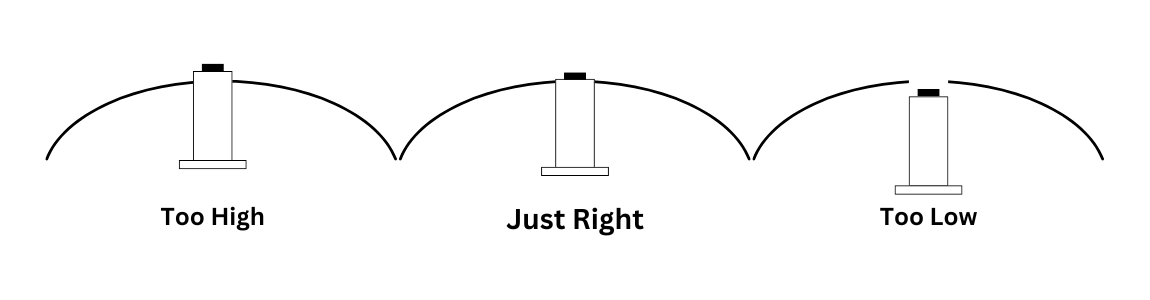
A correctly installed tire stud will have only the 1mm tungsten carbide pin protruding from the tire tread. A maximum of 1mm of the body may also protrude as the stud will seat correctly in this condition. Certain specialty studs and Rally racing studs have much more prominent protrusion. However, these rally type studs should not be driven on bare pavement.
Do studs ruin roads or fly out?
Extensive testing by highway departments throughout the world have concluded that modern winter tires and tire studs do much less damage to roads than the studs used 40 years ago. The use of radial tires, better road compounds and lighter weight studs have all contributed to significantly reduce road wear and rutting.
A properly installed tire stud has little chance of coming out of the tire during driving. The rubber of the tire compresses very strongly around the base flange of the stud and the rotational speed of the tire is not strong enough to dislodge the stud.
Tips to Properly Stud a Tire
- Safety first! Always wear protective eyewear.
- Measure the depth of the hole to be studded to find the proper tire stud size.
- Lubricate the hole with water for easier installation and to extend the life of your tool.
- Align the tip of the stud gun with the stud hole and press the tip firmly into it.
- Despress the stud gun trigger while maintaining downward pressure. Release the trigger.
A properly studded tire should appear to be nearly flush with the tire’s surface, with only the carbide pin and about 1/32” of the stud body visible. The stud should be straight, not leaning.
What products does Rubber-Inc carry?
If you’ve determined that tire studs are the right choice for your business and meet the needs of your customers, we are here to assist you.
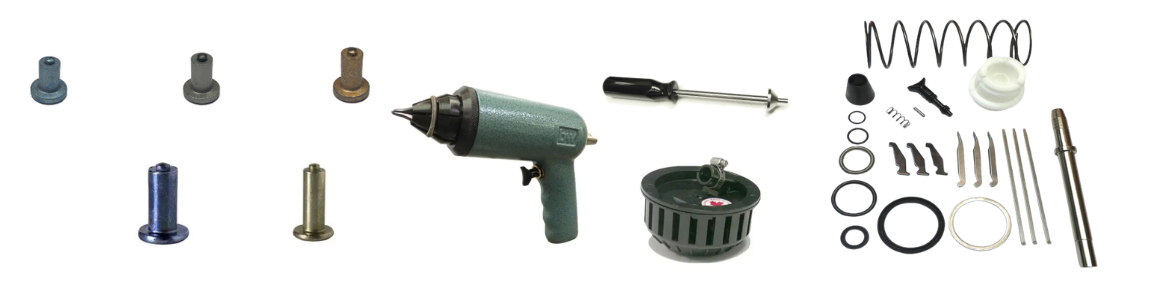
Our comprehensive line of Bruno Wessel Tire Studs include the TSMI#11, TSMI#12, TSMI#13, TSMI#14, and the TSMI#17. Additionally, we offer a range of essential tools and accessories, such as a tire stud insertion tool, a large stud feeder with motor, a mini-manual feeder, stud removal tool, and various repair kits. Click HERE for our full line of Bruno Wessel tire stud products.
Our inventory is always expanding. If you’re looking for a specific product that we currently don’t stock, we are happy to source it for you.
In review, tire studs can significantly enhance a vehicle's safety on icy roads and offer consistent performance in winter weather conditions. Summer is a great time to get ahead of the winter rush by pre-studding tires, ensuring they are ready to install when the weather changes.
While tire studs can be an essential for safe winter driving, it’s important to be aware that they can cause wear and tear on road surfaces. Therefore, it is extremely important to be aware of your state's stance on the use of tire studs.