

Get Prepared for the Season: Top 5 Questions Tire Shops Get About Studded Tires for Passenger Vehicles
Stud season brings the same five questions to your counter every year. Print this and keep it by the register, or hand it to a new hire before their first winter. It's built to get your team answering fast and accurate, so customers trust you and book the appointment instead of calling around.
1. "How do I know which size studs my tires need?"
Most studdable winter tires list the correct stud size right on the sidewall. If it's not marked, the tire needs to be measured before studding.
In North America, stud size is set by the TSMI (Tire Stud Manufacturers Institute) number, and it corresponds directly to the depth of the pre-molded stud hole. Measure the hole with a tread depth gauge: a 12/32" hole takes a TSMI #12 stud, a 13/32" hole takes a TSMI #13, and so on. Passenger and light truck tires typically run TSMI #11 through #17.
Two things worth telling customers plainly:
- Only tires built with pre-molded stud holes can be studded. A regular winter tire without those holes will be damaged if someone tries to force studs into it.
- It is recommended that only new tires be studded. Once a tire has been driven on, dirt and debris pack into the holes and the studs won't seat properly.
2. "Are studded tires even legal where I live?"
This is the question your team should never guess on. Legality varies state to state: roughly a dozen states ban metal studs outright, about 30 allow them only during a winter window, and a handful have no seasonal restriction at all. State stud laws get revisited more often than people expect, sometimes mid-season, so make it a habit to check your state DOT site each fall
The safest answer for your counter staff to give: point the customer to their state DOT site for the current rule, since these laws can change. Keep a laminated one-pager at the counter with your specific state's (and any neighboring states', if you're near a border) legal dates so staff aren't reciting this from memory. For more detail, see our article Where and When Can You Use Tire Studs? and LegalClarity's state-by-state guide.
3. "Will these damage my car or the roads?"
You'll hear this one a lot, mostly because studded tires are noisy on dry pavement and that noise makes people nervous. It's worth addressing head-on instead of brushing it off.
On the vehicle side: a properly installed stud sits nearly flush with the tread, with only the carbide tip and a sliver of the stud body exposed. Installed correctly, on the right tire, they aren't going to harm the car.
On the road side: yes, studs cause some pavement wear, which is exactly why states regulate them. The honest answer for a customer: studs trade a little extra road wear for a real gain in stopping distance and control on ice. That's a fair trade for someone who drives in genuinely icy conditions, and it's exactly why regulations exist in the first place, to balance that trade-off rather than ban studs outright.
4. "How long will they actually last?"
Studded tires typically last 3 to 6 winter seasons, depending on how many miles the customer drives and whether they're running on dry pavement more than ice or packed snow, which wears the studs down faster. Most customers keep a dedicated winter set: on around November, off in spring, same tires reused season after season until the tread or studs wear out.
Two clocks matter here: tread life, covered above, and legal life. Legal life is the state's window for driving on studs each year. Indiana, for example, allows them October 1 through May 1. Outside that window, the tires come off for the season, tread or no tread, and go back on next fall. Mentioning both sets up the next appointment.
5. "Studded or all-weather, which do I actually need?"
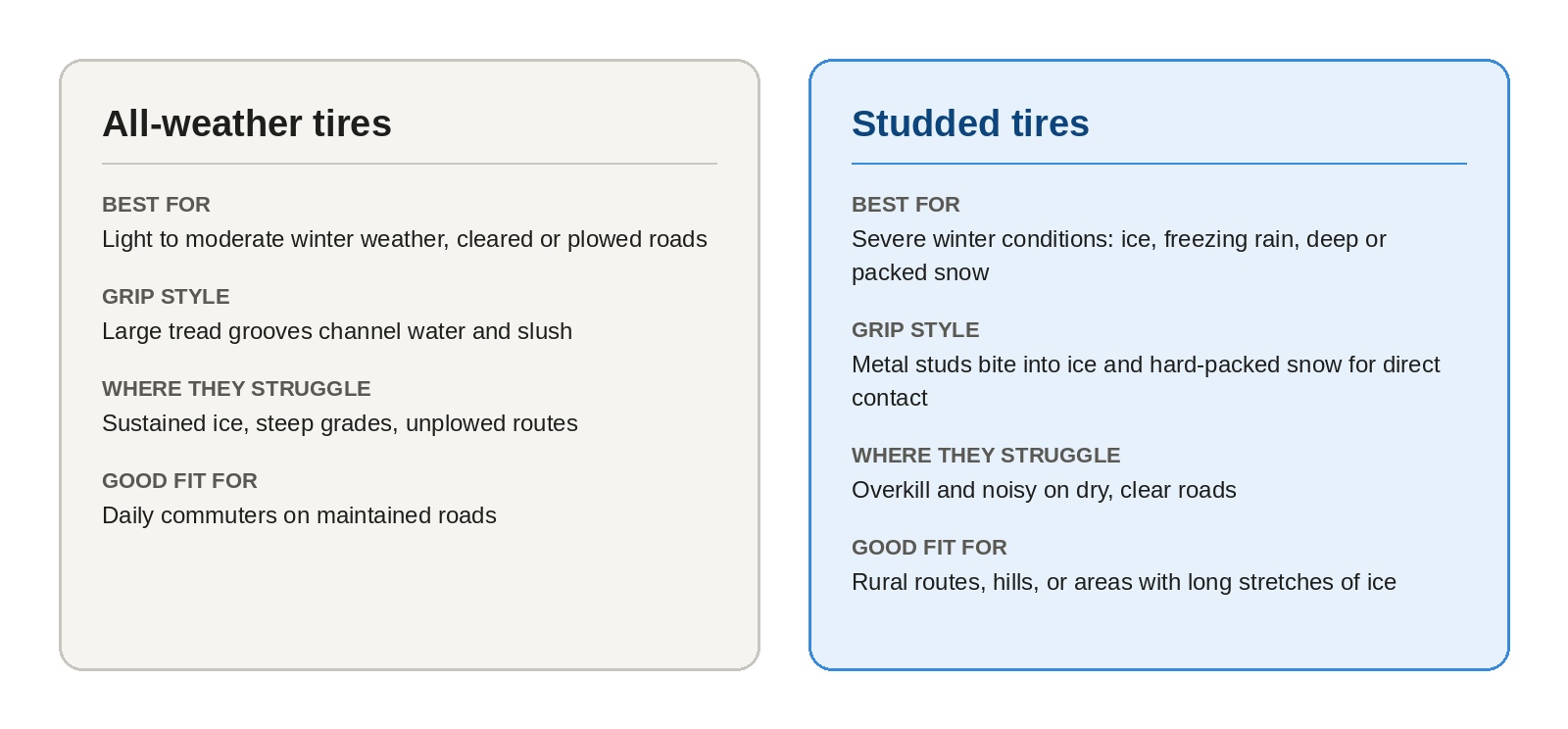
This is the question where you can genuinely help someone pick the right product, and it's the best upsell opportunity in the conversation.
All-weather tires
- Best for: light to moderate winter weather, cleared or plowed roads
- Grip style: large tread grooves channel water and slush
- Where they struggle: sustained ice, steep grades, unplowed routes
- Good fit for: daily commuters on maintained roads
Studded tires
- Best for: severe winter conditions, ice, freezing rain, deep or packed snow
- Grip style: metal studs bite into ice and hard-packed snow for direct contact
- Where they struggle: overkill and noisy on dry, clear roads
- Good fit for: rural routes, hills, or areas with long stretches of ice
Make This Work for Your Counter
Print this and keep it at the register, or hand it to every new hire before their first stud season. Five questions, five straight answers, no guessing at the counter. Less time re-explaining the basics on the floor means more time closing the sale.